
Getting your adoptable pets online: a small rescue's guide
Here’s an uncomfortable exercise: open your website and count how many of the animals listed are actually still available. For a lot of small rescues the honest answer is “some,” because the listings are updated by hand, by whoever has website access, whenever they remember.
Out-of-date listings are worse than no listings. An adopter falls for a dog who went home last month, emails you, waits two days for the bad news, and quietly moves on to a rescue whose website they trust.
The root problem: two sources of truth
Your records say Peanut is adopted. Your website says Peanut is available. Any system where those are updated separately will drift, not because your team is careless, but because updating a website is nobody’s favorite job and everybody’s last priority.
The fix is structural: your public listings should be generated from your records, not maintained alongside them. Mark the dog adopted in the place you already do it, and the website follows on its own, no edits, no waiting for the volunteer with the website login.
You don’t need a web developer for this
The objection we hear most from small rescues is “we don’t have anyone technical.” Fair, so the publishing options should meet you where you are:
- No website at all? A hosted public page listing your available animals works as your adoption page. Share the link on Facebook, in emails, anywhere.
- Have a website? Paste one snippet and the listings appear inside your existing site, matching your colors, resizing itself, staying in sync. Adding it is a one-time, two-minute job; after that, nobody touches it again.
- At events? Print a QR code that points to a pet’s page. Tape it to the kennel card. Visitors scan it and get photos, history, and the adoption application on their phone, while standing in front of the animal they’re falling for.
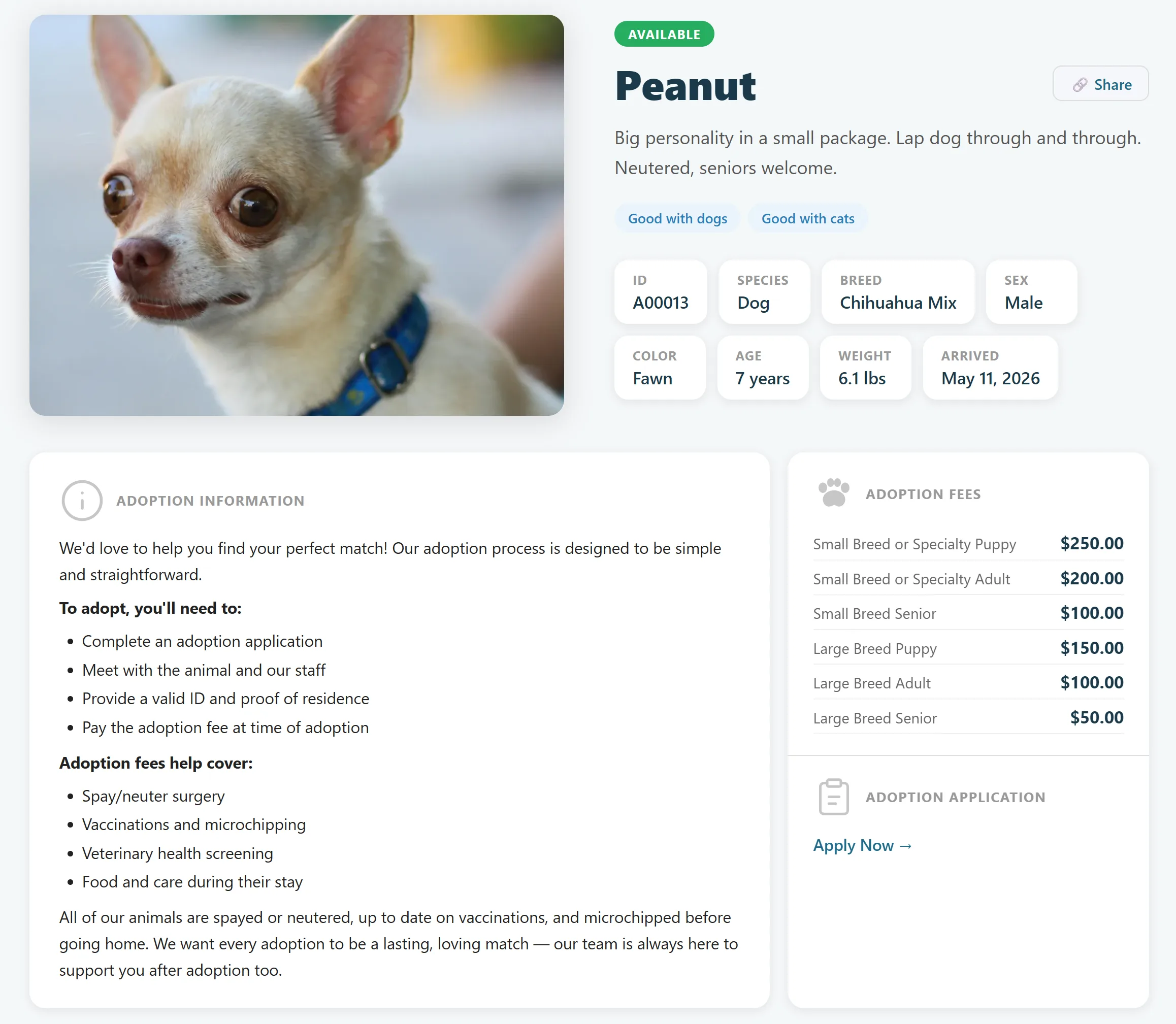
A public pet page generated from the record: photo, the honest basics, fees, and the application, all in one place.
What belongs on a public pet page
Adopters decide with their hearts and commit with details. The page for each animal should carry both:
- Photos first. Multiple, decent light, at least one where the animal isn’t terrified. Photos do more than any paragraph.
- The honest basics: species, breed, age, sex, size, and how long they’ve been with you.
- The personality note. Two sentences written by someone who knows the animal beat any template. “Lap dog through and through, needs a home without cats” saves everyone’s time in both directions.
- What happens next: fees, process, and the application itself, linked right on the page.
One thing that should not be public: everything else. Owner history, medical details beyond what adopters need, staff notes. Your system should let you choose what’s public per animal, and keep animals on medical hold or in legal limbo off the public list entirely.
The compounding payoff
A self-updating listing isn’t just less work. It changes what your website is: from a brochure someone built in 2019 into the living front door of your shelter. Every animal marked available shows up while they still need the visibility. Every adoption takes them down before anyone’s heart gets broken by a dog who already went home.
Furdentify gives every shelter hosted adoptable pet pages, an embeddable listing for your own website, shareable links, and QR codes, all updated the moment you update a record. See the features or get started.